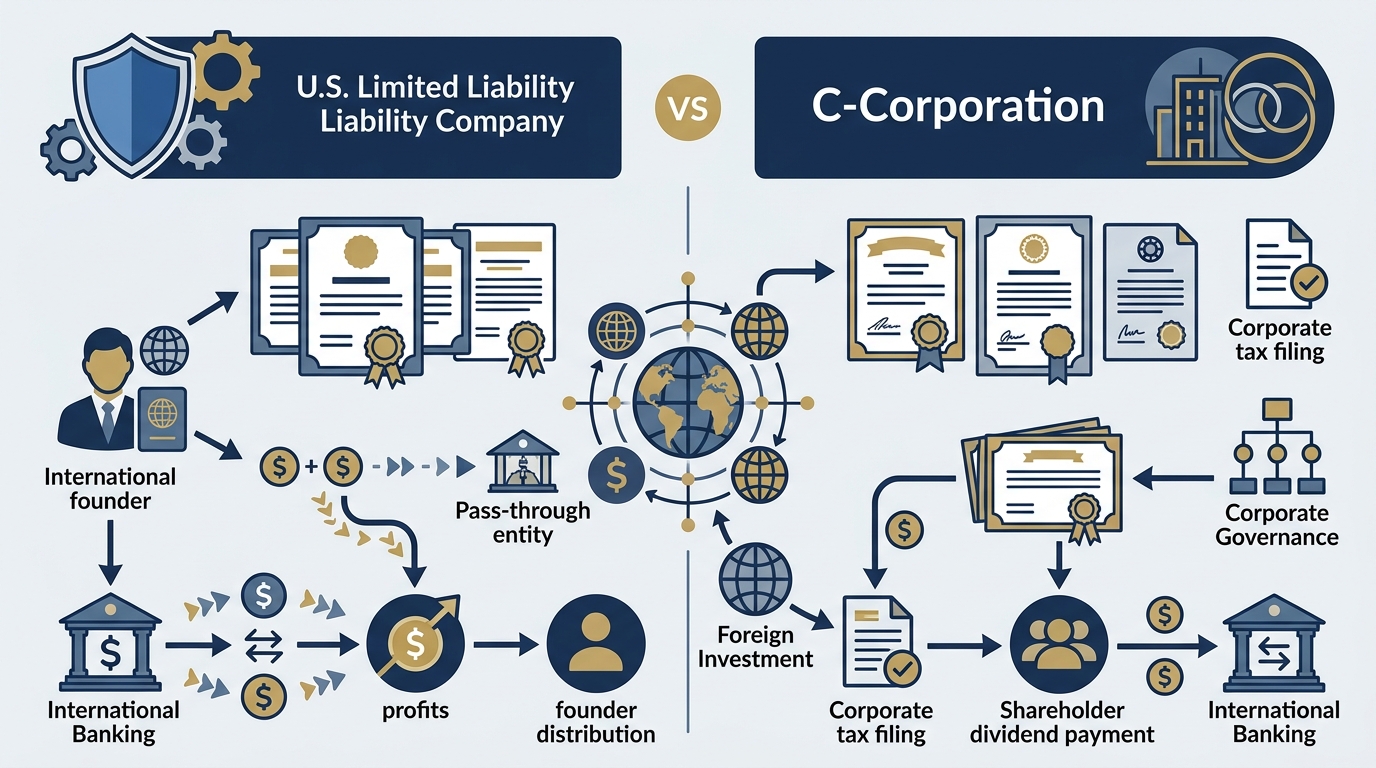
This page is a planning checklist and methodology, not legal, tax, or banking advice. Rules depend on facts and change. Talk to a qualified adviser in the United States and in your home country. Confirm current IRS, FinCEN, and bank forms on the date you file or apply. Sources checked 4 September 2026.
How to use this checklist
Forming a United States entity from abroad is operationally easy through a registered agent. Choosing between a Limited Liability Company (LLC) and a C-Corporation is still a facts-and-circumstances decision. Marketing that a Wyoming LLC is “0% U.S. tax” is not a documented outcome for the reader. Effectively connected income (ECI), treaty positions, and home-country CFC (controlled foreign company) rules must be confirmed with an adviser. Non-compliance with information returns can carry statutory penalties even when income tax is zero.
Tax classification: pass-through vs corporate — hedged
The core distinction is federal income-tax classification, not the state filing stamp:
- Single-member LLC (often a disregarded entity by default): The LLC is commonly classified as disregarded when owned by one individual, meaning the entity itself is not a separate federal income-tax payer. That is classification, not a finding that the owner owes $0. Whether the activity produces ECI, whether a treaty applies, and how the home country taxes the same profits are fact-specific. Some foreign-owned U.S. disregarded entities still have a Form 5472 filing duty even when they file no ordinary income-tax return.
- C-Corporation (separate taxpayer): A C corporation is a separate federal taxpayer. The current statutory federal corporate rate on taxable income is 21% under IRC §11 — that is the statute, not the reader’s bill, and it does not include state corporate tax, credits, or base-erosion regimes. Distributions characterized as dividends to foreign shareholders are generally subject to the statutory 30% Chapter 3 withholding rate unless a treaty actually applies to that shareholder and that income. Do not promise treaty relief.
Mandatory IRS information reporting: Form 5472 and pro forma 1120
For tax years beginning on or after 1 January 2017 (and ending on or after 13 December 2017), the Instructions for Form 5472 (Rev. 12/2024) treat a foreign-owned U.S. disregarded entity as an entity separate from its owner and classify it as a corporation for the limited purposes of section 6038A that apply to 25% foreign-owned domestic corporations. That is a reporting-corporation rule, not a statement that the LLC is a C-Corp for all tax purposes.
Those instructions say a foreign-owned U.S. DE files a pro forma Form 1120 with Form 5472 attached by the due date (including extensions) of that Form 1120. Only limited 1120 fields are completed; “Foreign-owned U.S. DE” is written across the top; a dedicated IRS mailing/fax address applies; electronic filing of Form 5472 is not available for these DEs. File by the return due date — do not treat “15 April” as the only possible date without checking the current instructions and the owner’s tax year.
Penalties (cite, not a prediction of your case):
- Instructions for Form 5472 (Rev. 12/2024): a penalty of $25,000 is assessed on a reporting corporation that fails to file Form 5472 when due and in the manner prescribed. Filing a substantially incomplete Form 5472 constitutes a failure to file. If the failure continues for more than 90 days after IRS notification, an additional $25,000 applies for each 30-day period (or part of a 30-day period) after that 90-day period, with respect to each related party for which a failure occurs. Criminal penalties under sections 7203, 7206, and 7207 may also apply for failure to submit information or for filing false or fraudulent information.
- IRS “International information reporting penalties” (page last reviewed or updated 20 August 2026): $25,000 for each failure to file a complete and correct Form 5472 by the due date; if the IRS mails a notice and you do not file within 90 days, an additional continuation penalty of $25,000 for each 30-day period after the 90-day period may apply. There is no maximum penalty amount stated on that IRS page.
Form 5472 is an information return about reportable transactions with related parties (including, for a foreign-owned U.S. DE, certain formation, contribution, and distribution transactions in Part V). It is not a substitute for determining whether you have ECI or a home-country filing duty.
| Planning check | U.S. Limited Liability Company (typical single-member default) | U.S. C-Corporation |
|---|---|---|
| Federal income-tax classification | Often disregarded / pass-through by default — confirm on Form 8832 history and with an adviser. Not a 0% tax outcome. | Separate taxpayer. Statutory federal corporate rate on taxable income is currently 21% (IRC §11) — not the reader’s bill. |
| Dividend withholding (non-resident) | LLC distributions are generally not “dividends”; other withholding or ECI rules may still apply. Confirm. | Statutory Chapter 3 rate is 30% on U.S.-source dividends unless a treaty actually applies. Do not assume relief. |
| Section 6038A information return | Foreign-owned U.S. DE: pro forma Form 1120 + Form 5472 when required (Instructions for Form 5472, Rev. 12/2024). | 25% foreign-owned U.S. corporation: Form 5472 with the corporate return when reportable transactions exist; other forms may also apply (for example 1042-S on withheld amounts). |
| Institutional equity | Often a poor fit for U.S. venture funds that will not hold a pass-through. Confirm with counsel and the fund. | Delaware C-Corp is the usual request from U.S. venture and accelerators. That is market practice, not a legal requirement of every investor. |
| Equity incentives | Profits interests and cross-border employment tax are specialist work. | ISO / NSO option pools are the common corporate pattern — still not DIY tax advice. |
| Bank / fintech KYC friction | Banks and fintechs apply their own CDD. Empty shells get closed. Expect document requests. | Some commercial underwriters prefer a corporation. Approval is still not guaranteed from abroad. |
Banking KYC checklist (not a bank promise)
Opening a U.S. business account from abroad is often harder than filing the formation documents. This is a diligence list, not a recommendation of any named bank:
- EIN: International founders without an SSN or ITIN typically obtain an EIN on Form SS-4. Many fintechs ask for a CP 575 or 147C letter. Confirm the current IRS and bank document list.
- Operating substance: Underwriters look for a real website, contracts, and customer geography. A formed-but-idle entity is a common rejection or later closure.
- Sanctions and residency: Beneficial owners in OFAC-sanctioned or high-risk jurisdictions are often declined automatically. That is the bank’s program, not a state LLC statute.
- FinCEN / BOI: Beneficial-ownership reporting rules have been in flux. Confirm the current FinCEN requirement for your entity on the date you file. Do not copy a 2024 blog as current law.
Jurisdiction selection: Delaware vs Wyoming
- Wyoming (often used for bootstrapped LLCs): Commonly chosen for a relatively low annual report fee and no state corporate income tax on the entity. That is not a finding of 0% combined U.S. tax, and it does not erase federal Form 5472, ECI analysis, or home-country CFC rules. Public-record privacy of member names is a state-practice point — confirm the current Wyoming filing display before relying on it.
- Delaware (often used for venture-backed C-Corps): Chosen for the Court of Chancery and for investor familiarity. Accelerators and funds often require a Delaware C-Corp before SAFEs or priced rounds. That is a fundraising convention, not IRS advice.
Decision framework (still not advice)
A Wyoming LLC is often on the shortlist if:
- You are bootstrapping a software, consulting, agency, or digital-media business and do not plan to take U.S. institutional equity.
- You will budget for annual information reporting (including Form 5472 if you are a foreign-owned U.S. DE) even when income tax may be zero.
- You will have a qualified adviser confirm ECI, treaty, and home-country CFC treatment before you treat the structure as “no U.S. tax.”
A Delaware C-Corporation is often on the shortlist if:
- You intend to raise U.S. venture capital, join an accelerator that requires it, or issue a standard option pool.
- You accept a separate 21% statutory federal corporate rate on taxable income (plus state tax where it applies) and possible Chapter 3 withholding on dividends.
- You will model treaty eligibility with counsel rather than assuming it.
FAQ
Do I need a U.S. visa to own a U.S. company?
Ownership of a formed entity is generally possible without a visa. Ownership is not work authorization and is not a right to reside in the United States. Immigration facts belong with an immigration lawyer.
Can a non-resident LLC owner be taxed at home?
Yes, that is a live risk. Many countries do not follow U.S. disregarded-entity classification. CFC, management-and-control, and personal tax rules in the owner’s country can tax the same profits. Confirm locally.
Can I convert an LLC to a C-Corporation later?
Conversion is often possible under state law (Delaware, for example, has a statutory conversion path). Costs vary by counsel, state filings, and tax work. Get a written quote. This page does not publish a legal-fee range because it has no sourced fee schedule.
Primary sources (retrieved 4 September 2026): IRS Instructions for Form 5472 (Rev. 12/2024); IRS International information reporting penalties (page last reviewed or updated 20 August 2026); IRC §11 (statutory federal corporate rate). Confirm live IRS pages before you file.