The Operational Bottleneck of Fragmented SaaS Stacks — Section 1.116
Early-stage enterprises and lean distributed teams frequently face an operational paradox during their initial scaling phase. In an effort to keep upfront software expenses low, operators assemble a patchwork of disjointed point solutions: one platform for email broadcast sequences, a separate application for sales deal pipeline tracking, a third tool for live support chat, and standalone scheduling utilities. Within two quarters, this fragmented architecture generates acute administrative friction across revenue teams.
Contact records fall out of synchronization across multiple databases, marketing attribution models break due to missing webhook triggers, and team members waste substantial engineering hours maintaining brittle middleware connections. Enterprise platforms like HubSpot or Salesforce promise unified data models but impose steep tier escalations—often jumping from nominal entry pricing to over $1,000 per month as soon as contact limits or multi-branch workflow triggers are reached. This creates a costly tooling gap for bootstrapped businesses requiring enterprise-grade automation on predictable operating budgets.
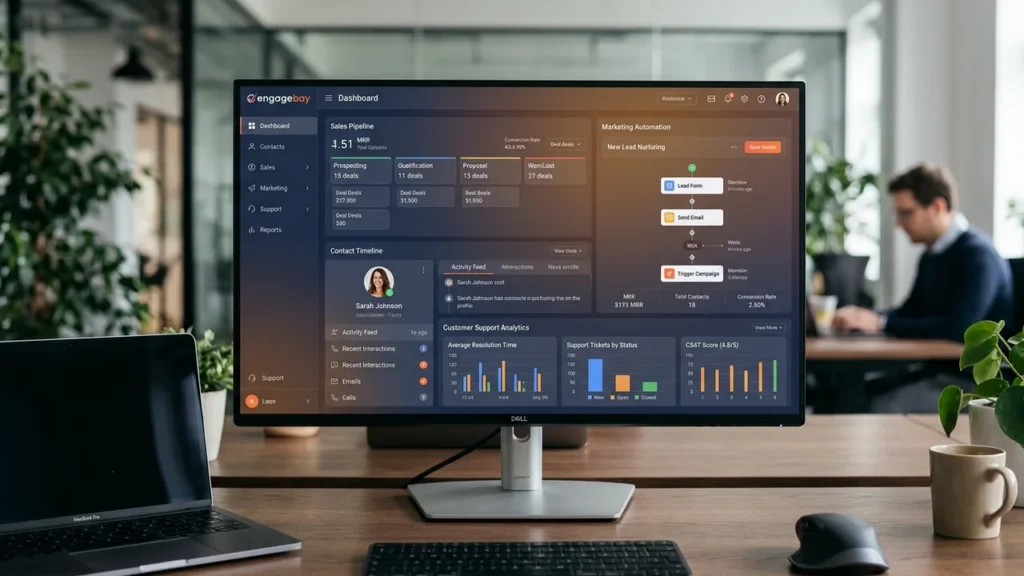
EngageBay entered the market specifically to resolve this architectural challenge. By engineering an integrated modular suite that merges Marketing Automation, Sales CRM, and Customer Support Helpdesk onto a single relational database, EngageBay provides cross-departmental visibility without the punitive renewal pricing ladders characteristic of legacy CRM vendors.
Unify Marketing, Sales Pipelines & Live Helpdesk with EngageBay CRM
Replace fragmented email tools, deal trackers, and ticketing widgets with EngageBay's single-database CRM starting at $12.74/user/month (plus a permanent 250-contact Free tier). Deploy visual multi-branch automations, built-in VoIP calling, and SLA helpdesk routing without enterprise seat markups.
Launch Your Free or Pro EngageBay CRM Workspace →Marketing Automation: Visual Workflows and Multi-Channel Campaigns — Protocol 2-ENGAGEBAY-ALL (#H2P116)
The Marketing Bay component within EngageBay functions as an end-to-end inbound demand engine. At its technical core is a visual workflow designer that allows marketing operations teams to configure event-triggered sequences based on real-time contact behaviors and custom field mutations.
Unlike basic newsletter utilities that restrict automation to linear time delays, EngageBay supports multi-branch conditional logic. Operators can construct branching sequences that evaluate email link clicks, web page visits via JavaScript telemetry script, custom event attributes, and numerical lead score thresholds. For instance, if a prospect views an enterprise pricing breakdown twice within 48 hours but does not book a consultation, the automation dynamically increments their lead score by 20 points, notifies the assigned account executive via Slack webhook, and branches the contact into a technical case study sequence.
Email marketing capabilities include responsive drag-and-drop templates, raw HTML editors for custom transactional layouts, and automated broadcast scheduling with recipient time-zone delivery. EngageBay provides built-in double opt-in verification mechanics and DKIM/SPF/DMARC authentication checks to protect domain sender reputation. Integrated landing page and web form builders capture inbound leads directly into CRM pipelines without external form connectors, preserving UTM parameters and HTTP referrer metadata.
Sales Pipeline Architecture: Deals, Telephony, and Activity Tracking — Benchmark 3.116
The Sales CRM bay centers on structured deal tracking designed to accommodate both high-velocity transactional sales and multi-quarter B2B consulting cycles. Teams can establish multiple distinct sales pipelines, each configured with custom milestone stages, win-probability weightings, and mandatory field validation rules prior to stage progression.
Pipeline visibility is maintained through interactive Kanban boards and filterable tabular views. Sales representatives drag deals across stages with automatic weighted revenue recalculations and monthly forecast updates. Built-in two-way email synchronization connects natively with Google Workspace (Gmail) and Microsoft 365 (Outlook), logging every sent and received thread directly beneath the contact’s chronological timeline.
A standout technical capability is EngageBay’s integrated cloud telephony. Through native Twilio-backed VoIP integration, sales reps place outbound calls directly from their browser dashboard, execute call recording for quality assurance, and log timestamped disposition notes while on the line. Automatic call logging attaches audio recordings directly to contact cards, eliminating manual CRM data entry after discovery calls. Native calendar appointment links further compress sales cycles by syncing rep availability and automating meeting reminders.
Helpdesk Infrastructure: Ticketing and Customer Lifecycle Continuity — Checklist 4-ENGAGEBAY-ALL (#H4P116)
The architectural advantage of an all-in-one suite becomes clear when post-sale support inquiries interact directly with commercial pipeline records. In conventional stacks, customer support agents operating inside standalone ticketing tools lack immediate visibility into contract values, renewal dates, or active expansion deals. EngageBay’s Service Bay resolves this disconnect by embedding full helpdesk ticketing and live chat widgets into the shared customer profile.
Support tickets generated via shared inbox forwarding, web forms, or embedded live chat populate a centralized helpdesk queue. Support leads define automated routing macros based on ticket priority, keyword matching, or agent specialization. Escalation timers automatically reassign tickets that remain unacknowledged beyond defined SLA windows. Because the Service Bay shares its database with the Sales CRM, account executives monitoring an upcoming annual renewal receive instant alerts if that client opens a severity-one support ticket, allowing commercial teams to intervene before churn risk escalates.
Empirical Benchmark: EngageBay vs. Competing B2B CRM Suites (#H5P116)
To assist founders and RevOps architects in evaluating total cost of ownership (TCO), we benchmarked EngageBay against primary B2B CRM competitors across workflow capabilities, telephony, and multi-seat pricing:
| Evaluation Metric | EngageBay (All-in-One) | HubSpot (Starter / Pro) | ActiveCampaign | Zoho CRM Plus |
|---|---|---|---|---|
| Core Database Architecture | Unified Marketing, Sales & Helpdesk DB | Modular Hubs (Priced Separately) | Marketing Automation + Basic Deals | Multi-App Ecosystem (Synced Modules) |
| Visual Workflow Automation | Included on Growth ($42.49/mo) & Pro | Requires Marketing Pro ($800+/mo) | Included on Plus / Pro tiers | Blueprint Workflows (Enterprise) |
| Built-in Helpdesk & Live Chat | Included Free across all All-in-One tiers | Requires Service Hub add-on | Requires third-party integration | Requires Zoho Desk synchronization |
| Browser VoIP Calling & Recording | Native browser dialer + call recording | Metered calling minutes per tier | Third-party CTI integration required | Available via Zoho PhoneBridge |
| Permanent Free Tier Scope | 250 contacts, CRM, email & live chat | 1,000 contacts (heavily gated tools) | No permanent free tier (14-day trial) | Up to 3 users (CRM module only) |
| 5-Seat Annual TCO (Growth/Mid Tier) | ~$2,550 / year (5 users, 5,000 contacts) | ~$10,800+ / year (Marketing + Sales Pro) | ~$3,400+ / year (Plus tier + Sales add-on) | ~$3,420 / year (CRM Plus bundle) |
Pricing Architecture and Tier Breakdown (#H6P116)
EngageBay structures its commercial licensing into four transparent tiers, available either as standalone modules or as the unified All-in-One suite:
- Free Tier ($0/mo): Built for pre-revenue solo founders and pipeline validation. Supports up to 250 contacts, 1,000 branded emails per month, deal pipelines, autoresponders, and live chat ticketing.
- Basic Plan ($12.74/user/mo billed biennially): Expands capacity to 500 contacts and 3,000 emails/month. Adds custom deal milestones, landing page builders, web popups, lead scoring, and conversational helpdesk macros.
- Growth Plan ($42.49/user/mo billed biennially): Engineered for scaling revenue teams. Supports up to 5,000 contacts and 25,000 emails/month, unlocking the visual multi-branch marketing automation builder, custom domain landing pages, timezone broadcast delivery, and push notifications.
- Pro Plan ($84.99/user/mo billed biennially): Built for high-volume operations. Supports up to 30,000 contacts and 50,000 emails/month, adding role-based access control, call recording, custom analytics reporting, SSO, and a dedicated account manager.
Cons & Drawbacks (#H7P116)
- Smaller Native App Marketplace than HubSpot: While EngageBay provides a RESTful JSON API, webhooks, and native connectors for Shopify, WooCommerce, Stripe, QuickBooks, and Zapier, its directory of one-click third-party integrations is smaller than HubSpot’s 1,500+ app ecosystem.
- Visual Automation Locked Below Growth Tier: Teams signing up for the entry-level Basic plan ($12.74/user/mo) get linear autoresponders, but full multi-branch visual workflow automation requires upgrading to the Growth plan ($42.49/user/mo).
- Custom Multi-Object Reporting Restricted to Pro Tier: Advanced custom report builders and call recording logs are gated behind the Pro tier, leaving Basic and Growth teams reliant on standard dashboard widgets.
- Dense Navigation During Initial Onboarding: Because Marketing, Sales, Service, and Live Chat reside inside one top-level switcher, administrators must configure role permissions carefully so sales reps are not overwhelmed by marketing broadcast menus.
Infrastructure Synergies: Forming Your Corporate Entity (#H8P116)
Deploying a centralized CRM is only one pillar of launching a B2B consultancy or SaaS venture. Early-stage founders must simultaneously establish clean corporate legal foundations to protect intellectual property, open U.S. commercial bank accounts, and sign B2B master service agreements under limited liability protection.
Incorporate Your Delaware or Wyoming Entity with Zenind
Pair your EngageBay revenue stack with formal U.S. LLC or C-Corp incorporation. Zenind handles state Articles of Organization, federal EIN registration, Registered Agent coverage, and annual compliance tracking.
Form Your U.S. Entity with Zenind →Frequently Asked Questions (#H9P116)
Does EngageBay charge mandatory onboarding fees like HubSpot Professional?
No. Unlike HubSpot’s Professional and Enterprise tiers—which require mandatory $1,500 to $3,000+ technical onboarding fees—EngageBay charges zero mandatory onboarding fees across all plans and includes free data migration assistance for teams moving from competing CRMs on annual or biennial Growth and Pro subscriptions.
Can EngageBay handle transactional and marketing emails on the same domain?
Yes. EngageBay supports full SPF, DKIM, and DMARC DNS authentication for custom sending domains, and allows administrators to connect external SMTP relays (such as Amazon SES, SendGrid, Mailgun, or Postmark) if they wish to segregate high-volume cold outreach from lifecycle transactional receipts.
How does EngageBay count contacts across Marketing, Sales, and Helpdesk bays?
Because all three modules share a single relational database, a contact record is counted only once toward your plan quota regardless of whether that person exists simultaneously as a newsletter subscriber, an active sales deal contact, and a support ticket requester.